

The Decider's Dilemma: Knowing When to Lead Alone and When to Build Consensus
Introduction
Different situations call for different decision-making processes. You must resolve the tension between factors including time constraints, follower buy-in, team development opportunities, and how much opportunity you have to correct a sub-optimal decision. A Coast Guard captain deciding whether to abandon a search and rescue mission as a hurricane approaches his position is facing a very different set of challenges than a manager deciding how to allocate three reserved parking spots among four managers who report directly to him.
The good news is that there is a model for navigating this complexity that has been validated by 50 years of research. The bad news is that it makes some faulty assumptions, and there have been some significant technological and social changes that place it in need of an update.
The Vroom-Yetton-Jago model (named after the three researchers who formulated it in the 70s and 80s) transformed participative decision making from a utopian ideal to a systematic method to understand when and how participation would lead to a better decision than simply having the boss tell everyone what to do.
The model categorizes participation in decisions along a scale ranging from autocratic (no one other than the boss participates in the decision) to delegated (the boss hands the decision to a specific individual and doesn’t participate in it himself) .
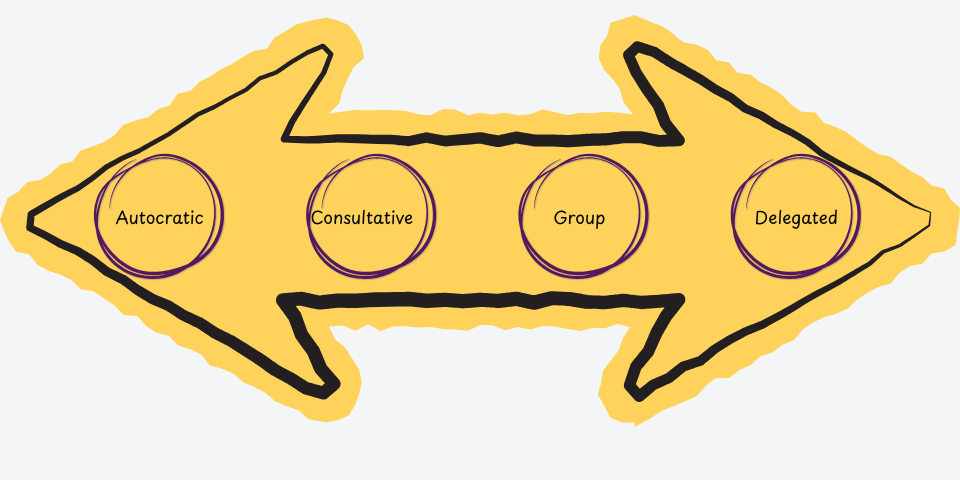
In Autocratic decision processes, the entirety of the decision falls to the boss. He may ask the team for information that he needs, but he does not ask for their recommendation. In Consultative processes, the boss asks members of the team, together or separately, for their recommendations, but the final decision is his. In Group processes, the boss puts the decision to the group and looks for either consensus or a democratic outcome. The boss only makes the decision alone if the group cannot get to a decision. Lastly, in Delegated processes, the boss chooses an employee who he judges to be capable of making a good decision and hands the entire process over to that person as an individual.
The original model created by Victor Vroom and Philip Yetton embodied the process in a pair of decision trees (one for problems affecting only an individual and one for problems affecting an entire group). Starting with the importance of the quality of the decision criteria, the model moved through each of the relevant criteria, asking a yes/no question to determine a route to a set of potentially useful participation models.
Several years later, Vroom collaborated with Arthur Jago to update the model. One of Jago’s principal contributions was the expression of the decision logic as an algebraic equation. Rather than asking yes or no, most of the criteria were scored along a scale. By combining the scores with a set of weights for criteria, you could purportedly determine the best fit participation model for any given decision. The increase in precision came at the cost of usability. For simplicity’s sake, I’ll refer to the model and its authors as VYJ and treat it as a singular entity for the rest of this post.
Despite how well the model has held to research studies, I can imagine at least three potential objections to it.
- The model is slow. Who has time to work a math problem every time she needs to make a decision? Vroom and Jago themselves point out that doing that would just be programming the manager rather than programming a computer to execute the model. Rather, their specific goal for the model was to use it in training sessions where a manager could compare how she would choose a model past decisions or case studies and compare it to the computer’s prescription. The intention was to internalize the categories and develop fluency and wisdom in selecting a participation model for a decision based on what would work best rather than defaulting to a preferred style.
- VYJ presumes that all decisions flow down. In fact, we all encounter problems where we (and our team) lack the knowledge to make a good decision and/or the authority to put it into practice. Sometimes, the right choice is to escalate the decision up the chain so that your boss can involve the necessary people.
- VYJ assumes that delegation is an express choice made with specific decisions. Since the model was published, there has been a movement toward empowering employees and pushing decisions as close to the edge of the organization as possible. When Vroom first started writing, he was making the case for increased participation. In many organizations today, participation is the functional default even for decisions where less participation might give a better result.
Making participation the default requires several things: explicit guidance about the goals and values of the organization, explicit guidance about an employee’s authority and limits in pursuit of those goals, and a culture that tolerates mistakes in judgment so long as they were made in a good faith effort to uphold the goals and values. At one point, Ritz-Carlton famously empowered every employee, from a hotel’s general manager all the way down to a housekeeper, to spend up to $2,000 per guest, per incident to solve a problem for a customer or create a “wow” moment.
VYJ’s Unchallenged Assumption
VYJ describes 12 criteria for categorizing decisions. Jago’s particular contribution was to formulate a mathematical expression involving the criteria. A manager could score each of the criteria then plug the results into the formula with different coefficients for each of the process types. The process with the highest score was the best fit for that decision.
Before we even get to the necessary updates to the model, let’s pause for a moment and recognize that this core assumption deserves to be challenged. Jago calls the outcome of the equation “decision effectiveness”. That promises way too much. Something like “participation model suitability” would be both humbler and more accurate.
VYJ treats decision making as deterministic rather than chaotic and probabilistic. While they don't explicitly say that the most effective decision necessarily leads to the most desirable result, it seems to me that their entire worldview is programmatic and linear. The model lends itself to the problem that Annie Duke calls "resulting". Resulting occurs when you judge the quality of a decision based on its outcome without accounting for random factors. In the real world, a bad decision sometimes gets a lucky break, and a good decision sometimes fails when uncontrollable factors move against you.
VYJ’s Criteria for Decision Making
The model attempts to quantify the appropriateness of participation using 12 factors. Some of these are scored on a 5-point scale. Others are simple binary choices.
Quality Requirement (QR)
All decisions are not created equal. On one extreme you have decisions with potential life and death impacts. For instance, following a 2009 incident in which a Toyota allegedly accelerated without the driver’s input, causing a fatal crash, Toyota recalled over nine million vehicles. In the end, it turned out there was no mechanical or electric fault. A dealer had installed the wrong floor mats, allowing the accelerator pedal to become stuck.
At the other extreme, you have decisions with essentially no ongoing consequences like whether to order pizza or sandwiches for a working lunch. Despite VYJ’s determinism, it prescribes more participation when the quality requirement is high. One of the strengths of the model is that it recognizes the value that comes from diverse sources of information.
Commitment Requirement (CR)
Some decisions will only be successful if the folks assigned to carry it out are completely bought the decision. Suppose you roll out a new product to your sales team, but they don’t see its benefit for their customers. They will meet their quota with other products, or they will leave the company.
For others, especially administrative decisions, it doesn’t matter whether people believe the right decision was made, only that they abide by it. I've yet to find a workplace where anyone was in love with the expense report system. Despite that everyone uses it, because they would like to get their expense checks.
Peter Drucker pointed out that “if time has to be spent on selling a decision, it has not been made properly and is unlikely to become effective .” If the commitment requirement is high, it should push you toward a greater degree of participation in the decision process.
Leader Information (LI)
VYJ defines “information” as technical and rational knowledge relevant to the problem. At lower levels of management, it is not unusual for leaders to have more technical expertise than many of their subordinates. As you rise through the ranks and spend more time directing the work rather than doing the work, it is likely that many of your subordinates’ technical knowledge will be more current than your own.
One example of someone making this decision poorly is Amazon’s release of the Fire Phone. Jeff Bezos overestimated his understanding of the phone market and dictated specific features to the product team that did not help the product win customers. As one insider put it, “In essence, we were not building the phone for the customer—we were building it for Jeff”.
Obviously, if you lack the information necessary to solve the problem by yourself, an autocratic decision is unlikely to work well. You should shift toward more participation. Experience reveals that many leaders either disregard this limitation or overestimate the value of their own information.
Problem Structure (ST)
VYJ defines the “structure” of the problem in terms of three criteria:
- Do you know the current situation?
- Do you know the goal?
- Do you know the set of alternatives for achieving the objective?
Novelty and uncertainty contribute to lack of structure. The leader’s familiarity with problems of the same kind contribute to a higher score for structure. Where problem structure is low, a higher degree of participation is necessary in order to clarify the goals and to generate more options for solving the problem.
Of course, structure is a judgment call, and it’s easy to trick yourself. In 2013, Target decided to expand into Canada via an acquisition and rebrand of Zellers. Gregg Steinhafel and his team seem to have assumed that Canada is basically the USA, but colder. The leadership team made the calls and ignored input from teams on the ground about software incompatibilities and differing consumer preferences. Two years later, Target abandoned Canada and recognized a 5.4 billion dollar loss.
Commitment Probability (CP)
VYJ frames commitment probability in terms of the question “If you were to make the decision by yourself, is it reasonably certain that your subordinates would be committed to the decision?” If you boil this question down to its essence, it is, “How much do people trust you?”
If Commitment Probability is high, less participation is needed. You can increase CP through by leveraging one or more power bases like charisma, trust, recognized expertise, and legitimacy.
This is another area where you can easily trick yourself. In 2012, Ron Johnson stepped into the CEO role at J.C. Penney with a ready-made plan to turn the company around. Fresh off massive successes with the Apple Store and Target (remember, this is before the Canada debacle), he assumed the frontline managers and store associates would trust him and his plan to eliminate sales and closeout racks and transition to an “everyday low prices” model. Instead, sales decreased by 4.3 billion in a single year, and Johnson was fired 17 months after taking the job. Arguably, he overestimated the problem structure as well as the CP, but in any case, workers who felt he didn’t understand the company weren’t invested in his new concept enough to put sincere effort into trying to make it work. Assume Commitment Probability is lower than you think it is.
Goal Congruence (GC)
Goal congruence assesses whether subordinates share the organizational goals that the decision is intended to advance. In practical terms, this likely has a great deal of overlap with Commitment Probability, and I suspect the correlation may overweight it in the model. In this criterion, VYJ is trying to determine whether a decision that advances the organizational goals also advances the goals of the individuals you lead.
As many writers have pointed out, you can’t really motivate another person. You can only show them how your goals align with their own. Where goals are in conflict, you can appeal to a sense of duty or express the degree to which you will be obliged to them if they “take one for the team”, but you must recognize that goal conflict creates a risk to the effective execution of the decision.
The history of poor relations between industrial management teams and labor unions is a treasure house of examples of leaders assuming goal congruence where it was absent. In 1992, Caterpillar CEO Donald Fites assumed that the need for global competitiveness would be obvious to the union. It was not. Management was ultimately successful in forcing the union back to work under their terms, but the company suffered a decade of lost productivity and the workers suffered years of frozen wages. Meanwhile, Japanese competitor Komatsu went from being a regional player to CAT’s primary global rival.
Subordinate Conflict (SC)
Assuming your subordinates agree about the goal, how likely are they to disagree about the best way to achieve it? This is what VYJ labels subordinate conflict. It is independent of Goal Congruence. Your subordinates might be entirely aligned to the organizational goal but offer radically different paths to move toward the goal. On the other hand, they might be united in their opposition to the organizational goal but share an understanding of the best way to advance it.
VYJ sees both a positive and negative aspects to subordinate conflict. On the negative side, it can increase both the time and cost needed to reach a decision. On the other hand, vigorously debating alternatives can lead to a higher quality decision in the end. VYJ argues that in every case where subordinate conflict might be present, the increase in quality and commitment justifies increasing participation.
As an example, they retell one of Peter Drucker’s stories about Alfred Sloan. Sloan was leading a meeting of one of GM’s top executive committees. For one particularly important decision, Sloan said to the group, “It appears we’re in complete agreement about this, correct?” Everyone around the table nodded. In response, Sloan said, “Very well, let’s table this decision until the next meeting to develop some disagreement so that we know what this decision is really about” .
Subordinate Information (SI)
The subordinate information criterion judges whether your team collectively has the information necessary to solve the problem. You are not making a judgment about their information relative to yours, but relative to the demands of the situation. As we pointed out above, for VYJ “information” is technical knowledge and skill. In the Suggested Updates section, I’ll critique that definition.
If you accept their definition, it’s usually the case that as you spend more time on management tasks and less on technical tasks, your team’s technical information becomes stronger than your own.
Time Constraint (TC)
A time constraint exists when a delay in making the decision will result in a disaster or a missed opportunity. Two diagnostic questions are helpful:
- Is this a situation where almost any reasonable choice would be better than doing nothing?
- Would the time necessary to gather input from the team prevent a decision from being made quickly enough?
The example I gave in the introduction of a Coast Guard captain needing to decide whether to abandon a search and rescue mission in the face of an oncoming storm is an example of a decision with a clear time constraint. It is one of the case studies that VYJ uses to teach the model.
Most of the VYJ questions are scored on a 5-point scale. Time Constraint is a simple binary. In their model, a time constraint either exists or doesn’t. Its presence pushed the decision toward the Autocratic end of their spectrum.
Geographical Dispersion (GD)
When the model was created, physical distance was a real problem. If a team was spread across even a relatively small area like the continental United States, assembling everyone for an effective real time group discussion required the expense, delay, and distraction of travel. Conference calls were an option but were limited in their effectiveness. Video conferencing was still in its infancy. It was expensive and required access to specialized hardware.
VYJ also treats GD as a binary factor. Its presence also pushed the decision toward the autocratic end of the spectrum.
Motivation-Time (MT)
VYJ’s definition of Motivation-Time is not well articulated. It is distinct from the presence of a time constraint and deals instead with the value that you as a decision maker place on time. The potentially confusing bit is that the mix both the subjective aspect of the decision maker’s preferences with the objective aspect of the opportunity cost of the time that participants will spend making the decision.
Because they define MT in relation to preferred managerial style rather than the situation, I can’t come up with a good illustration that all readers would interpret identically.
Motivation-Development (MD)
The Motivation-Development category recognizes that involving subordinates in decision making is an important way to give them opportunities to develop the skills that will prepare them for new roles and to observe those skills in action. MD and MT are almost always opposing forces, and it is unlikely that a leader will be able to maximize both for a single decision.
Motivation-Time and Motivation-Development are usually a trade-off. An individuals can always decide faster than a group. In many cases, if a leader delegates the decision to an individual, that person will likely have less experience making that decision than the manager . If a problem will get worse, or an opportunity will be missed because of delays in making the decision, VYJ correctly argues for using faster decision models.
What Updates Are Needed?
Subsequent research has largely validated the model, but it no longer receives the attention it once did so it hasn’t been directly evaluated in light of the last 20-30 years of technological and social change. This section is my judgment about the categories in the model that would likely stand up well to a present-day reevaluation.
The definitions and alternative questions for Quality Requirement, Commitment Requirement, Commitment Probability, and Goal Congruence all seem just as useful today as when The New Leadership was written.
Quality Requirement
The definition and alternative question for Quality Requirement still works, but the label is awkward and unintuitive. I suspect it could lead people to overestimate that criterion. To counter that, I suggest two additions to the alternative questions:
- What is the cost of being wrong?
- How easily can we change the decision after it has been made?
In Amazon’s 2015 shareholder letter, Jeff Bezos described the second question using the metaphor of one-way doors and two-way doors:
Some decisions are consequential and irreversible or nearly irreversible — one way doors — and these decisions must be made methodically, carefully, slowly, with great deliberation and consultation. If you walk through and don’t like what you see on the other side, you can’t get back to where you were before. We can call these Type 1 decisions. But most decisions aren’t like that — they are changeable, reversible — they’re two way doors. If you’ve made a suboptimal Type 2 decision, you don’t have to live with the consequences for that long. You can reopen the door and go back through. Type 2 decisions can and should be made quickly by high judgment individuals or small groups .
That description fits well with the example that VYJ gives for a low Quality Requirement decision, “What color should we paint the cafeteria?” If it turns out that we don’t like the color, it probably isn’t going to cause any actual damage to the company if we just live with it. If we decide that we can’t live with it, for a few thousand dollars, we can have the painters back out to try a different color.
Commitment Requirement
The definition and alternative questions for commitment requirement are as useful today as they were when The New Leadership was written.
Leader Information and Subordinate Information
As I noted when describing the criteria, VYJ explicitly defines “information” as technical and rational knowledge. First level managers are often promoted out of the group of individual contributors who perform the work. Their technical ability may be a factor in the decision to promote them. I would argue that it is usually overweighted in those decisions.
At the other end of the spectrum, senior leaders may have managers reporting to them who own functions that the leader has never worked in. You will not find a CEO who has worked in every function of a company.
I don’t want to dismiss technical knowledge entirely, but I would argue that information about the specific problem is at least equally important. There is a tendency for leaders to overestimate their own knowledge of situations. In group decision making, this can easily turn into the HiPPO in the room (the highest paid person's opinion). Some leaders allow themselves to become too distant from the customers and the production of the product or service. Consequently, they may have a highly accurate mental model of what the situation used to be rather than what it currently is. On the other hand, leaders are likely to possess more accurate information about the goals and priorities of the leaders above them than their subordinates do.
A second flaw of leader information and subordinate information is the implicit assumption that all decisions are made by a leader who chooses the degree of participation to give his direct subordinates. In today’s organizations, many decisions require cross-functional participation. I’m routinely called upon to make a decision, but it requires input from people in other parts of the organization, some of whom may have a more senior title than I do. Putting the decision into action may also require the commitment of people who have no reporting relationship to me.
Whether leader information or subordinate information is lacking, the guidance the Toyota Production System offers leaders is the correct: Genchi genbutsu. The term is usually rendered into English as “go and see”, but it literally means “actual place, actual thing”. Even if you think you know what’s going on, it’s worth the effort to go observe the process you are deciding about. In the worst case, you come away with greater confidence in your mental model and your data. In the best case, you learn something new that improves the decision.
Problem Structure
To solve the problems created by defining information too narrowly, VYJ plays a bit of a conceptual shell game. They give two alternative questions for this criterion.
- Are you familiar with problems of this kind?
- Do you know the current situation, the goals, and the alternatives for achieving these objectives?
These are not actually attributes of the problem. They are attributes of the manager.
As discussed above, VYJ should have considered the questions of familiarity with similar problems as elements of Leader Information and Subordinate Information. It is easy to imagine scenarios where a leader has experience with a kind of problem that none of his subordinates has experienced and situations where one or more of the subordinates has experience with a kind of problem the leader has not experienced.
In The Effective Executive, Drucker suggests that the first element of decision-making is to identify whether a problem is common or unique (the specific terms he uses are “generic” and “an exception”). He expands this further with a discussion of problems that are unique to the department or organization but that might be common across the industry or field of knowledge and a discussion of problems that appear to be unique but are actually early signs of the new normal.
Drucker’s classification is much more helpful. Rather than asking whether you or others in the organization know how to deal with the problem, ask whether anyone knows how to deal with this kind of problem. Doing that might suggest that rather than making an autocratic or a group decision about the solution, your next best step might be to bring in a consultant who can accelerate your understanding of the problem.
Commitment Probability
As mentioned in the introduction for this section, I do not believe any updates are needed for Commitment Probability.
Goal Congruence
As mentioned in the introduction for this section, I think this stands the test of time with no necessary revisions.
Subordinate Conflict
VYJ’s scoring scale for subordinate conflict only asks whether there will be conflict, not whether it is productive or unproductive. The best meetings I've been in had plenty of conflict. It was productive because the team cared about the long term health of the team as much as they cared about making a correct short term decision.
In their book Playing to Win, A.G. Lafley and Roger Martin suggest a method to turn conflict in a productive direction. Rather than debating whether a potential decision is the best option, reframe the discussion as “what would have to be true for this to be the correct decision?” Doing this transforms arguments about whose idea is going to win into collaborative problem solving discussions.
Subordinate Information
My thoughts on this mirror my thoughts on Leader Information. See the subsection on it above.
Time Constraint
VYJ’s alternative questions for Time Constraint only allow yes/no answers. The relationship between decisions and time is more complex than that. First, it matters whether the situation is stable or deteriorating. If the situation is getting worse, acting quickly mitigates damage (or amplifies the opportunity) and likely allows you more options. As Vroom points out, even the Cuban Missile Crisis allowed 13 days for decision making.
Delaying a decision usually increases the situational information available to you. However, other parties may take advantage of the time in the same way and reach a decision faster than you do.
Situations like the search and rescue case study have precise fixed deadlines. Most decisions don’t. Usually, the right way to think about time is to combine a judgment about probability and the net present value of the benefit of the right decision. Then you are weighing that expected value against the cost of and delay of deliberation.
A 5-point scale would be more suitable for this criterion.
Geographical Dispersion
Technology has eased the distance problem, but it hasn’t solved it completely. Today, everyone has multiple options for videoconferencing and screen sharing. There are still two major unsolved problems: temporal distance and media richness.
Temporal distance is the problem of time zones. If every participant lives in Europe or in continental United States, this is not much of a problem. There are 4-5 hours where everyone is available and reasonably well rested. Even if you have participants in both Europe and the Americas, there are several hours of overlap in the ordinary working day between most time zones. Sadly, this is not the case if you have team members in both Los Angeles and Dubai.
Between the eastern United States and Malaysia, depending on the time of year, there is either an 11-hour or 12-hour time difference. For people working an ordinary schedule, their working hours do not overlap at all. Every meeting means that someone is starting their day while it’s still dark, or they are coming back to work after dinner. Neither is conducive to good participation. It gets worse still when you need to include participants from Europe, the Americas, Asia, and Australia simultaneously. Someone will be waking up in the middle of the night to join the meeting.
Media richness is the ability of the meeting format to convey the full range of both factual and emotional information. When a team tries to make a decision over email or even synchronously in a messaging platform, not being able to hear tone of voice or see facial expressions can lead to misunderstanding. Video conferencing is a huge leap over that and voice only calls, but it still falls short of the information bandwidth of an in-person meeting. In person, not only can you see the faces of individuals, but you can observe how their posture changes, who or what they are looking at in each moment, and so on.
Motivation-Time and Motivation-Development
As defined in The New Leadership, these categories face the same challenge as Problem Structure. They are subjective, and their point of reference is the decision maker, not the problem. If Time Constraint is adjusted to recognize expected value and its time decay, as I have suggested above, Motivation-Time becomes superfluous.
As indicated in the description, MT and MD are a tradeoff. Consequently, you only need to consider the value of development to arrive at the same answer. MD is probabilistic and not subject to direct quantification. You can’t directly measure the units of development the team is likely to gain from working through a problem, but the gain you get lasts at least as long as the employee stays with the company. Longer, if it helps them become someone who can assist others in their development. By contrast, the savings you get from making the decision yourself apply only to that decision.
Development is systematically undervalued in most Western companies. The Toyota Production System intentionally builds development of problem-solving skills and participation into every job down to the factory line worker. It takes time to build a culture of development, but the agility and dedication to quality that the organization develops become a key source of competitive advantage.
Social Cohesion
The Commitment Probability criterion assesses how much the team trusts the leader. Unfortunately, VYJ doesn’t ask, “How much do members of the team trust each other?” When conflict is likely, the degree to which team members know and trust each other is critically important. Teams that know each other well can rely on a lot of unspoken understanding which speeds communication.
Team members don't necessarily need to like each other. They do need to be able to predict how others on the team will act, and they need to be able to trust that other team members will act with integrity (fully sharing the facts and abiding by commitments made during the decision process). This is another benefit to getting people together in person for decisions. It allows the team to spend time getting to know each other outside of the context of high stakes decisions, which can improve social cohesion.
Confidentiality / Secrecy
The model also doesn’t address requirements for secrecy or confidentiality. You may encounter decisions where you have to limit the people who are told about it. For example, you (or your superior) may not want information leaking about an upcoming acquisition, product launch, or layoff. This criterion would be binary, at least regarding specific people. If you can’t tell anyone, you are forced into an autocratic decision regardless of what the other criteria might indicate is optimal.
Conclusion
Formal validation of my hypotheses about improvements to the model would require a considerable amount of empirical research. From my informal observations over the years, my suggestions reflect the way that the best decision makers I’ve known think about decisions.
In terms of practical guidance for leaders, the essence of participative decision making comes down to six questions:
- How competent are you and each potential member of the decision-making team regarding the technical know-how and the facts of this specific decision?
- How much do you trust your people to make the right decision without your input?
- How much do your people trust you to decide without their input?
- How much does your team trust each other?
- How much value do you create by making the decision quickly?
- How much value do you create by using participation in the decision to develop your team?
Simplifying the questions makes them more qualitative than the rigorous quantified model that VYJ prescribes, but I would argue that much of the rigor is an illusion. Effective decision making requires wisdom more than cold calculation.